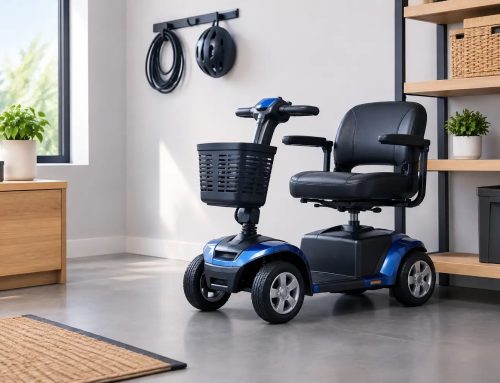


A powerchair can be the right size on paper and still catch on the bathroom door, scrape a skirting board or leave no room to turn into the kitchen. So, do powerchairs fit through doorways? Many do, but it depends on the chair’s overall width, the doorway’s true clear opening and the space available on either side of it.
For a first-time buyer, measuring the home before choosing a powerchair can prevent an expensive and frustrating mismatch. For someone replacing an existing chair, it is also worth measuring again. Door furniture, carpets, new flooring and a different chair design can all affect day-to-day access.
Do powerchairs fit through doorways in most UK homes?
Most compact and mid-size indoor or pavement powerchairs are designed with everyday door access in mind. However, not every powerchair will pass through every doorway. A narrow, older internal door can be challenging, while a wider front entrance may be easy to use but still have a tight turn immediately inside.
The key measurement is not simply the width of the door leaf. It is the clear opening width: the usable gap between the door and the frame when the door is open. Door stops, hinges and handles can reduce this space. A door described as 762 mm wide, for example, does not necessarily provide 762 mm of clear passage.
Many homes have internal doors with nominal widths around 686 mm, 762 mm or 838 mm. In practice, the available opening may be noticeably less. This is why a chair that is 610 mm wide may be comfortable through one door but too close for comfort through another, particularly where the user needs to approach at an angle.
Start with the powerchair’s widest point
When comparing models, check the overall width in the product specification. Do not assume the seat width is the width that matters. The widest point may be the drive wheels, armrests, mudguards or side panels.
Leave sensible clearance either side of the chair. A very small gap may be technically possible, but it is rarely practical for daily use. It can lead to damaged door frames, scuffed wheels and difficult manoeuvring, especially for a user with reduced hand control, sight loss or fatigue.
A useful approach is to measure the narrowest doorway on the route the chair will use. This might be the bathroom, utility room, kitchen or bedroom rather than the front door. Then compare that figure with the powerchair’s stated overall width, allowing room for normal steering corrections.
Measure the clear opening, not the frame
Open the door as far as it normally goes and measure the narrowest usable point from one side to the other. Measure at floor level and again around armrest height, as radiator pipes, trim or a projecting handle can create an obstruction higher up.
Also look at what happens when the door is fully open. In some halls, the door cannot open to 90 degrees because it meets a wall, radiator or furniture. That reduced opening can make a significant difference.
If there is a raised threshold, assess it separately. A chair may fit through the width of an entrance but struggle to cross a high, steep or damaged threshold safely. Small threshold ramps can help in some situations, but the correct option depends on the height, available length and the powerchair’s ground clearance.
Door width is only part of the question
Passing straight through an open doorway requires less space than turning through one. A powerchair approaching from a narrow corridor often needs room to line up before entering. Once through, the user may need sufficient space to turn, close the door or reverse out again.
Rear-wheel-drive powerchairs can offer strong outdoor performance and a familiar driving feel, but their turning circle may be less suited to confined rooms than a compact mid-wheel-drive model. Mid-wheel-drive chairs commonly turn within a tighter footprint and can be easier to position in kitchens, bedrooms and bathrooms. Front-wheel-drive designs can also work well in particular layouts, though their handling feels different and should be tried where possible.
The chair’s length matters too. A long powerchair may clear the doorway but require several manoeuvres to make the turn. If the home has narrow landings, short hallways or closely spaced doors, consider the turning radius and overall length alongside width.
Check everyday obstacles
Before making a decision, follow the route the chair will take from its storage and charging point to the rooms used most often. Check for:
- narrow halls and turns at the end of corridors
- doors that open into the route of travel
- thresholds, loose mats and changes in floor level
- furniture, radiators and low shelves
- tight space beside the bed, toilet or kitchen units
These details are not minor. A powerchair needs to work reliably on an ordinary morning, not only when rooms have been cleared for a measurement.
Choosing a powerchair for tighter doorways
Where internal access is limited, a compact powerchair may be more suitable than a larger outdoor model. Compact chairs are generally narrower and easier to turn, making them a practical choice for flats, bungalows and homes with smaller rooms. Some are designed principally for indoor use, while others can manage local outdoor journeys depending on their tyres, suspension, battery range and permitted use.
There is a trade-off. A smaller chair may have a lower top speed, less outdoor comfort, a shorter range or a lower user weight limit than a larger road-capable powerchair. It may also offer fewer seating adjustments. The right choice is the one that supports the user’s daily life without making the home difficult to use.
If outdoor travel is a priority but the house has restrictive doorways, it may be worth considering a compact chair for indoor use and a separate mobility solution for longer journeys. This is not necessary for every household, but it can be more practical than forcing one large chair to do every job.
Removable or narrower armrests are sometimes available, but do not rely on accessories to solve a fundamental width issue. Any adaptation must be compatible with the chair and must not affect safe support, controls or transfer access.
When changing the doorway makes more sense
Sometimes the home, rather than the powerchair, is the limiting factor. Widening a doorway, changing the direction in which a door opens or fitting a sliding or pocket door may make a room far more accessible. This can be particularly helpful for bathrooms, where space for a carer or transfer equipment may also be needed.
A lower threshold or suitable ramp can improve entry access, while a larger landing or reconfigured furniture can make turns easier. Major alterations should be planned carefully around the user’s needs, the property and any building requirements. A powerchair assessment and home adaptation advice can help identify the most effective route before work begins.
For rented properties, ask the landlord for permission before making alterations. In some cases, portable equipment or a less permanent adaptation may be the preferred option.
Test the route before you buy
Specifications provide a starting point, but a practical test is the best way to confirm suitability. If possible, test a similar-sized powerchair through the narrowest doors and around the tightest turns. Wear or use the items needed in everyday life, such as a coat, bag or oxygen equipment, so the test reflects normal use.
It is worth checking whether the user can open and close the door independently from the chair. A door that is easy to pass through may still be difficult to manage if the handle is too far away, the closer is too strong or there is no space to reverse.
Record the measurements and take photographs of difficult areas before discussing options with a mobility specialist. This makes it easier to compare chair dimensions accurately. Sheen Mobility can also help customers consider product specifications alongside practical home access requirements.
A well-chosen powerchair should give the user more freedom around their home, not create a daily obstacle at every doorway. Measure the real opening, allow for turning space and choose a chair that fits the routes that matter most.