

A toilet transfer can be one of the most difficult daily movements: sitting down in a controlled way, reaching the flush, managing clothing and standing again in a confined space. The right equipment can reduce strain, improve confidence and make personal care safer for the user and anyone assisting them. This disabled toilet equipment guide explains the main options for UK homes, and how to choose equipment that suits the person, the room and the level of support required.
Disabled toilet equipment guide: assess the space first
It is tempting to start with a product, particularly when support is needed quickly. A better starting point is the existing toilet area. Measure the height of the toilet seat from the floor, the clear space at both sides, the distance to the nearest wall and the width of the doorway. Consider whether a wheelchair, walking frame or carer needs room to approach and turn.
The user’s movement matters just as much as the measurements. Someone who can stand but finds bending painful may need a raised seat and a secure rail. A person with little standing balance, limited grip or one-sided weakness may need a toilet frame, drop-down support rail or a different transfer arrangement. If the person uses a wheelchair, the height of both the wheelchair seat and the toilet should be considered together.
Wall construction is particularly relevant for fixed rails. Grab rails and fold-down rails must be secured to a suitable structural surface, not simply attached to a lightweight partition. If there is any uncertainty, arrange professional fitting advice before buying. A rail that moves under load creates a serious risk.
Raised toilet seats and frames
A raised toilet seat is often the first equipment considered after hip or knee surgery, or where arthritis makes low seating painful. It increases the sitting height, reducing the depth of bend needed at the hips and knees. Models are available in different height increases, commonly around 2 to 6 inches, with or without a lid.
A basic raised seat fits directly onto the existing toilet pan. Check the shape and dimensions of the pan before choosing one, as not all seats fit every toilet securely. The seat should be stable, easy to clean and compatible with the user’s weight. Where frequent cleaning is needed, a smooth, wipe-clean design with accessible fixing points is usually more practical than a model with difficult-to-reach joints.
Raised seats with integral arms provide something to push from when standing. They can be useful where there is no room for separate side rails, but their width must be checked carefully. Arms can also restrict sideways transfers from a wheelchair, so they are not right for every user.
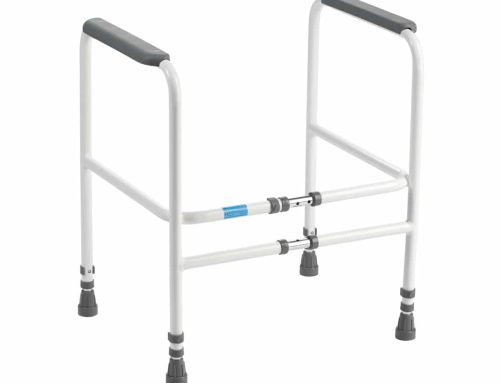
A free-standing toilet frame sits around the toilet and provides armrests on both sides. It is suitable where wall-mounted rails are not possible or where a temporary solution is needed. Many frames have adjustable legs, allowing the armrest height to be set for the user. Ensure all legs sit flat on the floor and that there is enough clearance to clean around the toilet. A frame should not rock, slide or rely on a loose bathroom rug for stability.
Grab rails and drop-down support rails
Grab rails give a stable handhold for sitting, standing and turning. They are available in straight, angled and folding designs. The best shape and position depend on how the person transfers rather than on appearance alone.
A straight rail beside the toilet can support a user who approaches from the front and pushes up with both hands. An angled rail may offer a more natural grip through the movement from sitting to standing. Textured or colour-contrasting rails can be easier to locate for people with reduced hand sensation or visual impairment, although a surface that is too abrasive can be uncomfortable for regular use.
Drop-down rails fold up against the wall when not in use and are commonly used where side support is needed but floor space must be kept clear. They can be particularly helpful for wheelchair users who transfer sideways, provided the rail is positioned on the useful transfer side. Some models include a leg for additional support and some include a toilet-roll holder. The latter is convenient, but should not dictate rail placement.
Do not place rails based only on what looks symmetrical. The stronger side, preferred hand and usual transfer direction should guide the decision. For a person with weakness on one side, an occupational therapist can advise on the safest set-up.
Toilets with added support and hygiene features
For long-term needs, replacing the toilet itself may be more suitable than adding several separate aids. Comfort-height toilets have a higher pan than standard models and can offer a more permanent, easier-to-clean solution. They may also work well alongside fixed rails in an adapted bathroom or wet room.
A wash and dry toilet provides water cleansing and warm-air drying, reducing the need to reach, twist or rely on toilet paper. This can support independence for people with reduced shoulder movement, poor hand dexterity, tremor or fatigue. Features vary significantly between models. Look at the control type, seat height, weight limit, cleaning cycle, drying settings and whether controls are usable with limited vision or hand strength.
Some users prefer a remote control, while others find a simple side control easier to manage. A carer should also be able to operate the toilet safely when assistance is required. These systems need electrical installation and, depending on the model, may have plumbing or water-pressure requirements. They are a larger investment than a raised seat, but can reduce the need for hands-on personal care in the right circumstances.
Equipment for urgent, temporary and overnight needs
A bedside commode can be useful when reaching the bathroom is unsafe, particularly after an operation, during illness or overnight. It should be selected with the same care as toilet equipment: check the seat height, armrests, weight limit, pan capacity and ease of cleaning. A commode must be positioned on a level surface with a clear route around it, not where it creates a trip hazard.
Wheeled shower commodes are designed for users who need support during both toileting and washing. They can reduce the number of transfers needed in an accessible bathroom or wet room. However, they need sufficient manoeuvring space, appropriate flooring and a carer who understands safe moving and handling. They are not simply a substitute for a standard wheelchair.
For people at risk of falling or unable to call out reliably, a personal alarm or call system may add reassurance. It does not replace physical support, but it can make it easier to summon help after a transfer or during an urgent need to use the toilet.
Choosing equipment safely
Before ordering, confirm these practical points:
- The user’s current and expected weight, including any clothing or transfer equipment.
- Toilet height, pan shape, floor space and door clearance.
- Whether the person transfers forwards, sideways or with carer support.
- The fixing surface and whether professional installation is required.
- How the equipment will be cleaned, emptied, charged or maintained.
Avoid treating a stated maximum user weight as the only measure of suitability. The equipment also needs to be stable for the user’s movement pattern. For example, someone who leans heavily to one side while standing may place force on a rail or frame differently from someone who rises evenly with both hands.
Temporary equipment can be a sensible choice during recovery, especially where needs are likely to change over weeks or months. For progressive conditions or permanent access needs, it may be more cost-effective to plan a complete toilet or bathroom adaptation. A higher toilet, properly fitted support rails and enough turning space often work better together than a collection of short-term aids.
If the person rents their home, speak to the landlord before making permanent alterations. In all homes, retain fitting instructions and arrange checks if rails, seats or frames become loose, cracked or difficult to adjust. Equipment should be cleaned regularly, particularly around seat fixings and commode pans, as residue can affect hygiene and make moving parts harder to use.
Where transfers are difficult, painful or involve a risk of falling, seek an occupational therapy assessment through local adult social care, the NHS or an independent specialist. An assessment can identify whether equipment is enough or whether changes to the room, a hoist or a different care approach are needed.
The most useful toilet equipment is the equipment a person can use safely every day, without rushing, overreaching or losing balance. Start with the transfer, measure the room carefully and choose support that leaves the user with as much independence and dignity as possible.