


A staircase can turn a suitable home into a difficult one very quickly. For many households, a homelift for wheelchair users is not a luxury upgrade but a practical way to keep everyday living on one property level without giving up space, safety or independence.
The right lift can make upstairs bedrooms, bathrooms and living areas accessible again. The wrong one can create new problems – awkward entry, limited turning room, avoidable building work or controls that do not suit the user. That is why it helps to look at homelifts in the same way you would any major mobility purchase: by matching the product to the person, the property and the level of support needed over time.
What makes a homelift for wheelchair users different?
Not every domestic lift is designed with wheelchair access in mind. Some compact home lifts are suitable for standing passengers or seated users only, and that distinction matters. A homelift for wheelchair users needs enough internal platform space for the wheelchair itself, plus safe entry and exit at each level.
That usually means looking beyond the smallest footprint models. Door width, cabin dimensions, weight capacity and approach space outside the lift all need proper attention. If the user relies on a larger powered wheelchair, the lift may need significantly more room than a manual chair would require.
Ease of use is just as important as size. Controls should be reachable from a seated position and simple to operate. A lift that technically fits a wheelchair is not much use if the user cannot press the controls comfortably or position themselves safely inside.
Start with the wheelchair, not the lift
A common mistake is to begin with the product brochure. In practice, the wheelchair is the starting point. Measure its width, length, turning circle and overall user weight with any bags, accessories or medical equipment that normally travel with it.
If the chair is powered, check whether the user drives straight in or needs space to adjust position. Some people can reverse out confidently, while others need through-access or a less restricted cabin layout. That can change which lift designs are practical.
This also applies if the current chair may change in future. A household adapting for long-term use should think ahead. Choosing a lift that only just accommodates the current wheelchair can become expensive if mobility needs progress and a larger chair is introduced later.
Property layout matters more than brochure dimensions
A lift may fit on paper and still be awkward in daily use. The available floor area is only one part of the decision. You also need to consider where the user approaches the lift from, how doors will open, and whether there is enough landing space upstairs and downstairs.
In some homes, the obvious location is near the stairs. In others, a corner of a lounge, hallway or dining room provides a better route. Through-floor homelifts are often chosen because they can travel between two levels without needing a full lift shaft, but they still require a suitable structural position and clear space around the opening.
For wheelchair users, approach angles are particularly important. If the user has to make a tight turn before entering, the lift may feel difficult from day one. A slightly larger installation area with straighter access can be far more practical than squeezing a unit into the smallest possible space.
Safety features worth paying attention to
Safety should be considered in day-to-day terms, not just technical compliance. Most buyers expect emergency stop functions, obstruction sensors and battery lowering in the event of a power cut, and these are sensible features to check. But there are other practical points that often matter just as much.
Door operation is one. A heavy or awkward manual door may be manageable during a demonstration and frustrating after six months of daily use. Flooring is another. A low threshold and stable, non-slip surface can make entry easier, especially for users with limited control or carers assisting transfers.
You should also consider how the lift behaves in an emergency. If the user may spend time alone at home, simple controls, alarm functions and predictable operation become more important. A homelift should reduce reliance on others, not create uncertainty each time it is used.
Weight capacity and real-world use
Published weight limits need a bit of interpretation. A lift must support the combined weight of the wheelchair, user and anything carried with them. That may include oxygen equipment, shopping, a walking aid or help from a carer in some circumstances.
It is usually better to leave a comfortable margin rather than choosing a model that only just meets the requirement. The same applies to cabin space. A unit that technically meets the load rating may still feel cramped if the wheelchair fits too tightly or the user cannot position themselves comfortably.
For larger powered chairs, bariatric users or households planning for changing care needs, capacity can quickly become the deciding factor. This is one of the clearest examples of where the cheapest option is not always the most suitable one.
Installation: simple does not always mean easy
Many domestic lifts are marketed as straightforward to install, and compared with a traditional passenger lift that can be true. Even so, installation is rarely a plug-and-play purchase. There may be structural work, electrical requirements, flooring changes or reconfiguration of the rooms at either stop.
This is where practical advice matters. A retailer or supplier should be able to explain what is needed in plain terms: how much space the lift takes up, whether building work is likely, how long installation usually takes, and what disruption to expect.
Older properties can present extra considerations. Uneven floors, limited hallway width and room layouts not designed for modern accessibility can all affect the final choice. Newer homes may be easier to adapt, but even then, access routes and furniture layout need attention.
H2 considerations that affect price
Cost is often one of the first questions, and reasonably so. A homelift for wheelchair users is a major purchase, and pricing varies according to lift size, travel height, structural requirements, weight capacity and finish options.
The visible purchase price is only part of the picture. You also need to account for survey work, installation, any associated building alterations and ongoing servicing. Some households focus heavily on the initial quote and then find that access works, electrical preparation or layout changes add more than expected.
That does not mean a lift is poor value. In many cases, it can be a more suitable long-term option than moving home or limiting living to one floor. But buyers should compare total project cost, not just the advertised unit price.
Servicing and aftercare are part of the decision
A lift is not a one-off purchase you can forget about. Like other mobility equipment, it needs routine maintenance and dependable support. Before buying, ask how servicing is handled, what call-out arrangements exist, and how faults are dealt with if the lift stops working.
This matters even more where the lift is the main route to bedrooms or bathrooms. If the user cannot manage stairs at all, downtime becomes a serious issue rather than a minor inconvenience.
An established mobility specialist with a wider service offer can be useful here. Sheen Mobility, for example, operates across multiple mobility categories and supports customers with more than just product supply, which is often important when households are making bigger accessibility decisions.
When a homelift is the right choice – and when it may not be
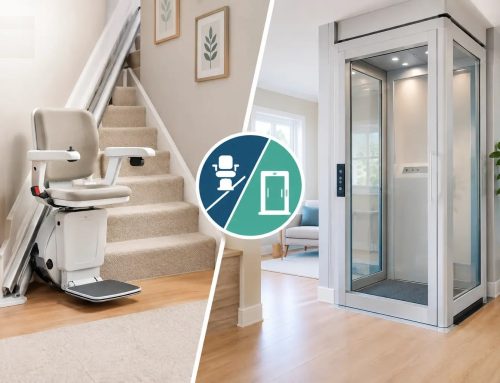
A homelift can be an excellent solution, but it is not the answer in every property. If space is extremely limited, if the user only needs support on the stairs rather than wheelchair access between floors, or if major structural work is not realistic, a stairlift or platform lift may be more practical.
The right choice depends on how the wheelchair is used inside the home. If the user transfers out of the chair for stairs, one option may work. If they need to stay in the wheelchair throughout the journey, that narrows the field quickly.
There is also the question of who else uses the home. A lift should fit the household routine, not dominate it unnecessarily. Some models are more discreet and compact than others, but the trade-off can be internal space. Again, it comes back to balancing property constraints with actual day-to-day use.
Questions worth asking before you buy
Before committing, ask for clear answers on internal dimensions, safe load, wheelchair suitability, power failure operation, servicing intervals and likely installation work. Ask whether the quoted model suits your exact wheelchair, not wheelchairs in general.
If a family member or carer is involved, include them early. They may spot practical issues around transfers, positioning or emergency use that are easy to miss during initial research. Good decisions usually come from looking at the routine in full – who uses the lift, how often, at what times, and with what support.
A homelift should make the home easier to live in from the first day, not simply tick an accessibility box. When the lift suits both the wheelchair user and the property, it can turn an upstairs room back into part of everyday life, which is often the point that matters most.