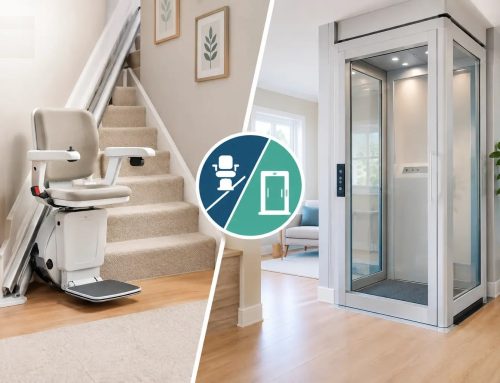



When a staircase starts to feel like the hardest part of the day, the question usually becomes practical very quickly – should you choose a straight stairlift or curved stairlift? The right answer depends less on preference and more on the shape of your stairs, how quickly you need installation, and what level of fit and finish your home requires.
For many households, this is not a small purchase and it is rarely made in ideal circumstances. It may follow a fall, a hospital discharge, or a gradual change in mobility that has reached the point where stairs are no longer manageable. That is why it helps to compare both options clearly, without jargon.
Straight stairlift or curved stairlift: the core difference
The main difference is in the track, not the seat. A straight stairlift is designed for a staircase that runs in one uninterrupted line, from bottom to top, with no turns, bends or intermediate landings. Because the rail is standardised, straight models are usually simpler to specify and quicker to install.
A curved stairlift is made for stairs that change direction. This includes staircases with corners, half-landings, spiral elements, or any shape that is not a single straight run. The rail is made to follow the exact layout of the staircase, which means the fit is far more bespoke.
That distinction affects price, lead time and installation planning. It also affects whether a stairlift can park neatly out of the way at the top or bottom, which matters in tighter hallways.
When a straight stairlift is the right choice
If your staircase goes directly up without turning, a straight stairlift is usually the most straightforward solution. In practical terms, that often means a lower overall cost and a shorter wait for fitting. For someone who needs safe stair access quickly, that can be a major advantage.
Straight stairlifts are also easier to replace or upgrade because the rail format is less complex. If a property already has a suitable straight track, or if you are looking at a reconditioned option, there may be further savings. For families balancing mobility needs with a fixed budget, this can make the decision simpler.
That said, the staircase still needs to be assessed properly. Width, doorways near the top or bottom, radiator placement and obstructions such as bannisters can all affect what model will fit comfortably. A staircase may look simple at first glance but still need careful measurement.
Typical benefits of a straight stairlift
A straight stairlift generally offers the fastest route from survey to installation. It is often more cost-effective than a curved model, and servicing or parts replacement can be less complicated because the system is not built around a custom-made rail.
This option suits many standard UK homes, particularly terraced and semi-detached properties with a single flight of stairs. It can also work well when the priority is restoring safe access upstairs without making broader home alterations.
When a curved stairlift is necessary
If your stairs have any turn at all, a curved stairlift is normally the only suitable stairlift option. That includes stairs with one bend, two bends, quarter-turn landings, or more unusual layouts. In these cases, trying to force a straight model into the plan is simply not realistic.
A curved stairlift is built around your staircase rather than adapted from a standard format. The track is manufactured to match the dimensions and direction of travel in your home, allowing the chair to move safely around bends and arrive at the correct stopping point. This is often the difference between a workable installation and one that blocks access or creates awkward transfers.
Curved models can also be useful where parking positions matter. In some homes, the best place for the chair is not directly at the top or bottom of the main stair run. A custom rail can sometimes allow the lift to park around a corner or away from a doorway, leaving the staircase clearer for other people in the house.
Why curved stairlifts cost more
The higher cost is mainly due to the rail being made to order. Surveying is more detailed, manufacturing is bespoke, and installation has less margin for adjustment on the day. This does not mean a curved stairlift is overpriced – it means the product is tailored to a more complex staircase.
For many buyers, the real comparison is not straight versus curved on price alone. It is whether the home layout requires a custom solution in order to make upstairs rooms accessible again. If it does, the curved option is not an upgrade for the sake of it. It is the correct fit.
Cost, lead time and value
When comparing a straight stairlift or curved stairlift, cost is often the first point people ask about. In most cases, straight stairlifts are less expensive to buy and quicker to install. Curved stairlifts usually involve a higher initial spend and a longer lead time because of the bespoke rail.
However, value is not just about the ticket price. A stairlift that fits the staircase properly, parks safely, and supports everyday use without awkward transfers is usually better value than a cheaper option that compromises access. This is particularly true if the user has limited balance, reduced stamina or pain when standing.
It is also worth factoring in aftercare. Servicing, repairs, warranty cover and ongoing support matter with any stairlift. A reliable supply and service provider can make a significant difference over the life of the equipment, especially for users who depend on it every day.
Space, safety and everyday use
The best stairlift is not only the one that fits the stairs. It is the one the user feels confident using. Seat height, swivel function, footrest position and remote controls all affect daily usability.
On a straight staircase, a standard rail may leave enough room for others to use the stairs normally. On a curved staircase, the route of the rail needs more planning so that doors, hallways and landings still function properly. Folding rails can help in some properties where a doorway sits close to the bottom of the stairs.
Safety features are important in both types. Most models include a seat belt, obstruction sensors and battery backup so the lift can still operate during a power cut. What varies more is the installation design around the staircase itself. A good survey should identify where the chair will start, where it will stop, and how the user will get on and off with the least risk.
Buying for yourself or for a family member
If you are choosing on behalf of a parent, partner or relative, it helps to focus on practical routines rather than product jargon. Where do they struggle most? Is the problem climbing the stairs, turning at the landing, or managing safely at the top? Do they need a quick solution after illness or discharge from hospital, or are you planning ahead before things worsen?
These details often point to the right option faster than price alone. A straight stairlift may suit an urgent need in a standard property. A curved stairlift may be essential in a house where the upstairs bathroom or bedroom would otherwise become difficult to reach.
This is also where a specialist retailer can be helpful. A provider such as Sheen Mobility can support both straightforward product enquiries and wider accessibility planning, which matters when stair access is only one part of a larger change at home.
How to decide between a straight stairlift or curved stairlift
Start with the staircase shape. If it is one straight run with no bends or landings, a straight stairlift is usually the likely option. If it turns, splits, or wraps around a landing, a curved stairlift is usually required.
After that, think about timing, budget and daily use. If speed and lower cost are the priority, and the staircase allows it, straight models are often the easier route. If the home layout is more complex, a curved model will usually deliver the safer and more practical result.
The key is not to treat these as interchangeable products. They solve the same access problem in different ways, and the staircase itself makes much of the decision for you.
A good stairlift should make the home feel usable again, not force the user to work around the equipment. That is the standard worth aiming for when you are choosing between the two.