

A flat tyre can stop a planned trip to the shops, a visit with family or an essential appointment. Knowing the basics of mobility scooter puncture repair helps you make a safe decision quickly, whether the tyre needs a simple repair, an inner tube replacement or professional attention.
The right approach depends on your scooter, the type of tyre fitted and where the damage has occurred. Small portable scooters may be straightforward to work on, while larger road scooters can have heavy wheels, more complex brakes or motor components that should be handled by a trained technician.
Start with safety before checking the tyre
If you feel the scooter pulling to one side, becoming harder to steer or riding unusually low, stop as soon as it is safe to do so. Do not continue travelling on a flat pneumatic tyre. Riding on it can damage the tyre wall, wheel rim, inner tube and, in some cases, the drive components.
Switch off the scooter, remove the key and make sure it is on level, firm ground. If you are out and about, move away from traffic before inspecting the wheel. Avoid placing hands near the motor, brake lever or moving parts while the scooter is powered.
Look for an obvious cause such as a thorn, screw, shard of glass or split in the tyre. Do not pull out an object immediately if the tyre is still holding some air. It may help identify the puncture location, and removing it can allow the tyre to deflate completely.
Is it a puncture or another tyre problem?
A tyre that looks flat is not always punctured. Pneumatic mobility scooter tyres naturally lose a small amount of pressure over time, particularly during colder weather. A tyre that has gradually become soft may simply need inflating to the pressure stated in the scooter handbook or on the tyre sidewall.
If it goes soft again within hours or days, there is likely to be a slow puncture, a faulty valve or damage to the inner tube. Check the valve cap is present and the valve is not bent or leaking. Cracks in an older tyre, a bulge in the sidewall or badly worn tread are signs that replacement is safer than a repair.
Solid tyres cannot puncture because they contain no air. However, they can still wear down, crack or become loose on the wheel. If a solid tyre has come away from the rim or the wheel feels unstable, stop using the scooter and arrange an inspection.
Why tyre type matters
Most mobility scooters use either pneumatic tyres with inner tubes, tubeless pneumatic tyres or solid tyres. Inner-tube tyres are common and often repairable, but the wheel usually needs to be removed to access the tube. Tubeless tyres may be repaired in some circumstances, though a damaged tyre bead or sidewall normally means a replacement tyre is required.
Solid tyres reduce the risk of being stranded by a puncture and can be a practical choice for regular use on smooth pavements. The trade-off is a firmer ride and less cushioning over uneven surfaces. Pneumatic tyres usually provide greater comfort and grip, provided pressures are checked regularly.
Mobility scooter puncture repair options
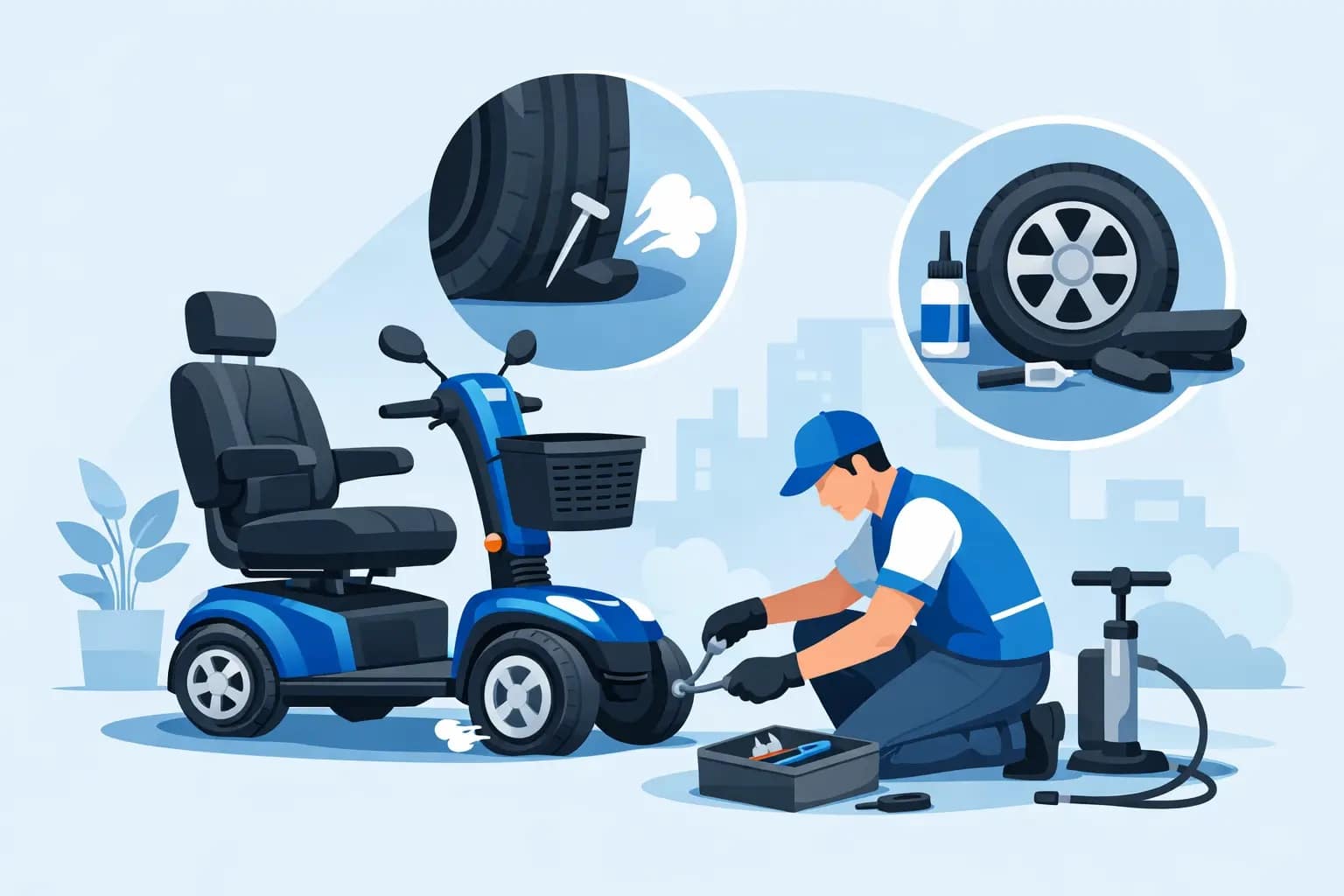
For a small puncture in the tread area, a repair may be possible. The tyre must first be removed or opened enough to identify the exact damage. With an inner-tube wheel, the tube is taken out, checked for the hole and either patched with a suitable repair kit or replaced.
Replacing the tube is often the more dependable option where the existing tube is aged, has multiple patches or has been run flat. It also avoids the risk of a temporary patch failing during a journey. The outer tyre should be inspected carefully before fitting a new tube. Any thorn, glass or sharp debris left inside can puncture the replacement tube straight away.
A tyre should generally be replaced rather than repaired when the puncture is in the sidewall, the casing is split, the tread is heavily worn or there is a visible bulge. Sidewall damage affects the tyre’s structure and is not a suitable place for a patch or plug.
Tyre sealants can be useful for preventing or slowing very small tread punctures, but they are not a cure for damaged tyres or a substitute for correct pressure. Some sealants are not appropriate for every wheel and may make later repairs messier. Check that the product is compatible with your tyre and wheel arrangement before using it.
Can you repair it yourself?
A confident owner may be able to repair a puncture on a basic scooter wheel, particularly where the wheel is easy to remove and the handbook gives clear instructions. You will usually need the correct spanners, tyre levers, a puncture repair kit or new inner tube, a suitable pump and a pressure gauge.
There are important limits. Never work on a scooter supported only by a car jack, and do not place it on an unstable chair, box or kerb. The scooter must be securely supported before a wheel is removed. Larger scooters are heavy, so this may be a two-person task.
Take particular care with drive wheels. Some models have hub motors, brake assemblies, wiring or a gearbox arrangement close to the wheel. Removing these incorrectly can cause further faults or affect safe operation. If you cannot see a straightforward wheel fixing in the handbook, or the scooter has an electrical connection at the wheel, booking a service visit is the sensible option.
A practical repair check
Once a repaired or replacement tube is fitted, inflate the tyre gradually to the manufacturer-recommended pressure. Check that the tyre bead is seated evenly around the rim and that no section of the inner tube is trapped between the tyre and rim. Refit all wheel fixings as specified for your model.
Before returning to normal use, test the scooter at walking pace on level ground. Check that it tracks straight, the steering feels normal and the brakes operate correctly. If the scooter vibrates, pulls to one side or makes an unfamiliar noise, stop and have it checked.
When to arrange professional servicing
Professional help is recommended if the scooter is under warranty, the wheel is motorised, the tyre has split, the rim is bent or the same wheel repeatedly loses pressure. A technician can identify whether the fault is a puncture, valve issue, damaged wheel, worn tyre or fitting problem.
Servicing is also useful for people who cannot safely lift, bend or work close to the ground. A puncture is frustrating enough without risking a strain or fall while attempting a repair. For many users and carers, arranging a repair is quicker and safer than sourcing parts and dismantling a wheel at home.
Sheen Mobility can support customers with mobility scooter servicing, helping to keep tyres, brakes, batteries and general scooter operation in suitable condition. When contacting a service provider, have the scooter make and model available, along with the wheel affected and any visible tyre size markings.
Reduce the chance of another flat tyre
Punctures cannot always be avoided, but regular checks make them less likely. Check tyre pressure at least once a month, and more often if the scooter is used daily. Underinflated tyres are more vulnerable to pinch punctures, wear faster and can reduce battery range because the motor has to work harder.
Before setting off, look over the tread for embedded stones, glass or sharp debris. Avoid riding through building waste, broken glass, deep potholes and kerb edges where possible. Use dropped kerbs rather than mounting a high kerb directly, and approach uneven surfaces slowly.
Tyres should be replaced before the tread becomes very shallow or cracks begin to appear. The cost of a new tyre or inner tube is usually less disruptive than being stranded on a route you rely on. If punctures are a recurring concern, ask about suitable puncture-resistant tyres, sealant options or solid-tyre alternatives for your particular scooter.
A well-maintained scooter gives you more confidence to travel independently. Keeping tyres correctly inflated, dealing with damage promptly and choosing professional support when a repair is beyond your comfort level will help keep everyday journeys moving.