

Choosing between a manual wheelchair vs transit chair usually comes down to one practical question: will the person sitting in it need to propel themselves, or will someone else always be available to push? The two can look similar at first glance, but their wheel size, handling and everyday suitability are very different. Selecting the right type can make journeys, appointments and use around the home far more comfortable for both the user and carer.
Manual wheelchair vs transit chair: the main difference
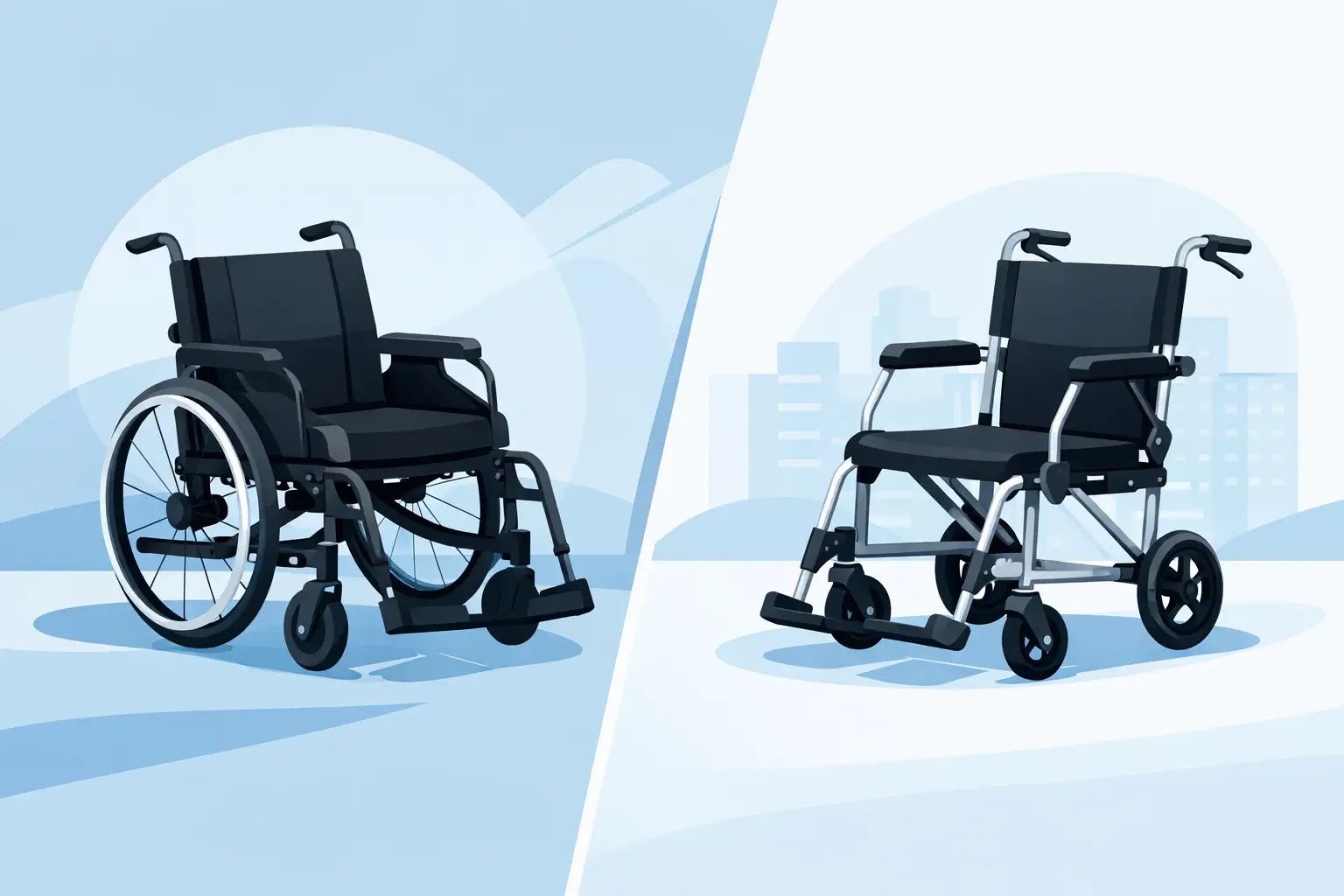
A manual wheelchair is normally self-propelled. It has large rear wheels with hand rims, allowing the user to move independently on suitable surfaces. Most models also have push handles, so a family member or carer can assist when needed.
A transit chair, sometimes called an attendant-propelled wheelchair, is designed to be pushed by another person. It has four smaller wheels and is generally lighter and more compact than a self-propelled wheelchair. The smaller rear wheels do not have hand rims, so the seated user cannot propel the chair themselves.
Neither option is automatically better. The right choice depends on the user’s upper-body strength, confidence, environment, travel plans and the level of support available day to day.
When a manual wheelchair is the better choice
A self-propelled manual wheelchair suits people who want or need more independence. The large rear wheels give the user leverage to move across indoor floors, pavements and other reasonably even ground without relying on another person. For someone who uses a wheelchair regularly, this control can be central to maintaining an active routine.
It can also reduce the amount of pushing required from a carer. A companion can still help with slopes, longer distances, rougher paths or fatigue, but the user is not dependent on them for every movement. This flexibility is particularly useful at home, in shops, around work or education settings, and when visiting friends and family.
The trade-off is size and weight. Larger wheels take up more room in a car boot and can make a chair less convenient in narrow hallways, tight café seating areas or compact storage spaces. Folding models are available, but it is worth checking the folded dimensions as well as the overall chair weight. A lightweight frame is easier to lift, but it must still offer the seat support and maximum user weight required.
A manual wheelchair may not be the best fit if the user has limited arm, shoulder or hand strength. Propelling a chair over distance can be tiring, especially outdoors or on uneven surfaces. In this situation, a transit chair, a powerchair or a power-assist option may be more appropriate depending on the person’s needs.
Features to consider on a self-propelled wheelchair
Seat width and depth affect both comfort and posture. A seat that is too narrow can cause pressure and restrict movement, while one that is too wide may make it harder to reach the wheels effectively. The user should also be able to sit with adequate thigh support and room for warmer clothing if the chair will be used outside.
Look at the armrests, footrests and backrest as a complete seating setup. Desk-length armrests can make it easier to approach a table, while detachable or swing-away footrests can help with transfers. Puncture-proof tyres reduce maintenance, whereas pneumatic tyres can offer a more comfortable ride but need regular pressure checks.
When a transit chair is the better choice
A transit chair is often the practical answer for short trips and occasional use. It is a popular choice for hospital appointments, shopping centres, family outings, holidays and situations where a relative or carer will be pushing throughout. Because the wheels are smaller, many transit chairs are easier to fold, lift and store in a car.
For a person recovering from surgery, living with temporary reduced mobility or walking short distances but needing support for longer outings, a transit chair can provide a straightforward solution. It is also useful where indoor space is limited and the chair will not be used for independent movement around the home.
The key limitation is reliance on an attendant. If the person using the chair is left alone, even briefly, they cannot move themselves away from an obstacle, reach another room or reposition their chair independently. That can feel restrictive for some users and may be unsuitable where the carer’s availability changes from day to day.
Transit chairs are usually intended for smooth, controlled surfaces rather than frequent use on rough ground. Small castors and rear wheels can be more affected by kerbs, gravel, uneven paving and steep slopes. A carer should be comfortable controlling the chair, particularly when going downhill, and should use the parking brakes whenever the user is getting in or out.
What carers should check before buying
For an attendant-propelled chair, handle height and grip are worth checking. If the handles are too low or awkwardly positioned, pushing can become uncomfortable on longer journeys. Some models include ergonomic handles or attendant brakes, which give the person pushing more control on slopes.
Consider how the chair will get in and out of the car. Check whether the frame folds, whether the footrests detach, and whether the heaviest part can be safely lifted by the person who will usually handle it. A compact chair is useful, but only if it still gives the seated person appropriate support.
Comfort, safety and fit matter more than price alone
A wheelchair should be chosen around the person, not simply around the lowest price or smallest folded size. A chair that is uncomfortable can discourage use and may cause poor posture, rubbing or pressure problems. This is especially relevant for users who sit for extended periods, have reduced sensation, or find it difficult to adjust their own position.
Check the product’s maximum user weight, seat dimensions and overall width. Overall width matters for doorways at home, access through shop aisles and fitting alongside other passengers in a vehicle. Measure the narrowest internal door or route before ordering, rather than assuming a standard wheelchair will fit.
Brakes should be easy to reach and operate. On a self-propelled chair, the user needs to be able to apply the brakes before transferring. On a transit chair, the carer must make sure the brakes are engaged before the person sits down, stands up or is left stationary.
Footrests should support the feet without forcing the knees too high or allowing the feet to drag. For users with poor leg control, heel loops, calf straps or elevating leg rests may be useful. Anti-tip wheels can provide additional reassurance on certain self-propelled models, although they do not remove the need for safe handling on slopes and kerbs.
Transport and vehicle use
Many people buy a transit chair because it is easier to take in a car, but it should not be assumed that any wheelchair can be used as a vehicle seat. A standard wheelchair is generally designed for use outside the vehicle and should be folded and stored safely where possible.
If a person needs to remain in their wheelchair while travelling, the chair and vehicle restraint system must be suitable for that purpose. Look for clear crash-test or transport-safety information and seek specialist advice before relying on a wheelchair for occupied transport. A vehicle-adapted solution may be needed for regular journeys.
For either chair type, plan the full journey. This includes lifting the chair, opening it at the destination, managing kerbs and checking whether accessible toilets, lifts and entrances are available. A chair that works well in the sitting room may be less suitable for a railway platform or a long day out.
Questions to ask before choosing
Start with where the chair will be used most. Indoor use on level floors places different demands on a chair than daily outdoor travel. Then consider whether the user can self-propel comfortably, including after they have been sitting for a while or when travelling over carpet, paving or slight inclines.
It is also useful to think about who will push, lift and maintain the chair. A transit chair may be light enough for one family member to manage but too heavy for another. If several people will use it as carers, choose a model that works safely for everyone.
Finally, consider whether the need is temporary, occasional or long term. Hiring can be a sensible option after an operation, during recovery or when equipment needs are still changing. For ongoing use, it is usually worth spending more time on fit, support and features rather than choosing solely for portability.
The best chair is the one that makes everyday movement feel manageable. If independence is the priority, a self-propelled manual wheelchair is often the stronger option. If compact transport and carer assistance are the priority, a transit chair may be exactly what is needed. Sheen Mobility can help customers compare practical specifications so the chosen chair suits the person, the journey and the home it will be used in.