

A transfer can be one of the most demanding parts of the day, particularly when moving between a bed, wheelchair, chair, toilet or bath. Choosing between a ceiling hoist vs floor hoist is not simply a matter of available space or initial cost. The right option depends on the user’s mobility, the carer’s needs, the layout of the home and whether the equipment needs to work in one room or across several areas.
Both types of hoist can support safer, more dignified transfers when selected, fitted and used correctly. However, they solve different practical problems. A careful assessment before purchase is essential, particularly where a person has limited weight-bearing ability, complex postural needs or requires assistance from more than one carer.
Ceiling Hoist vs Floor Hoist: The Main Difference
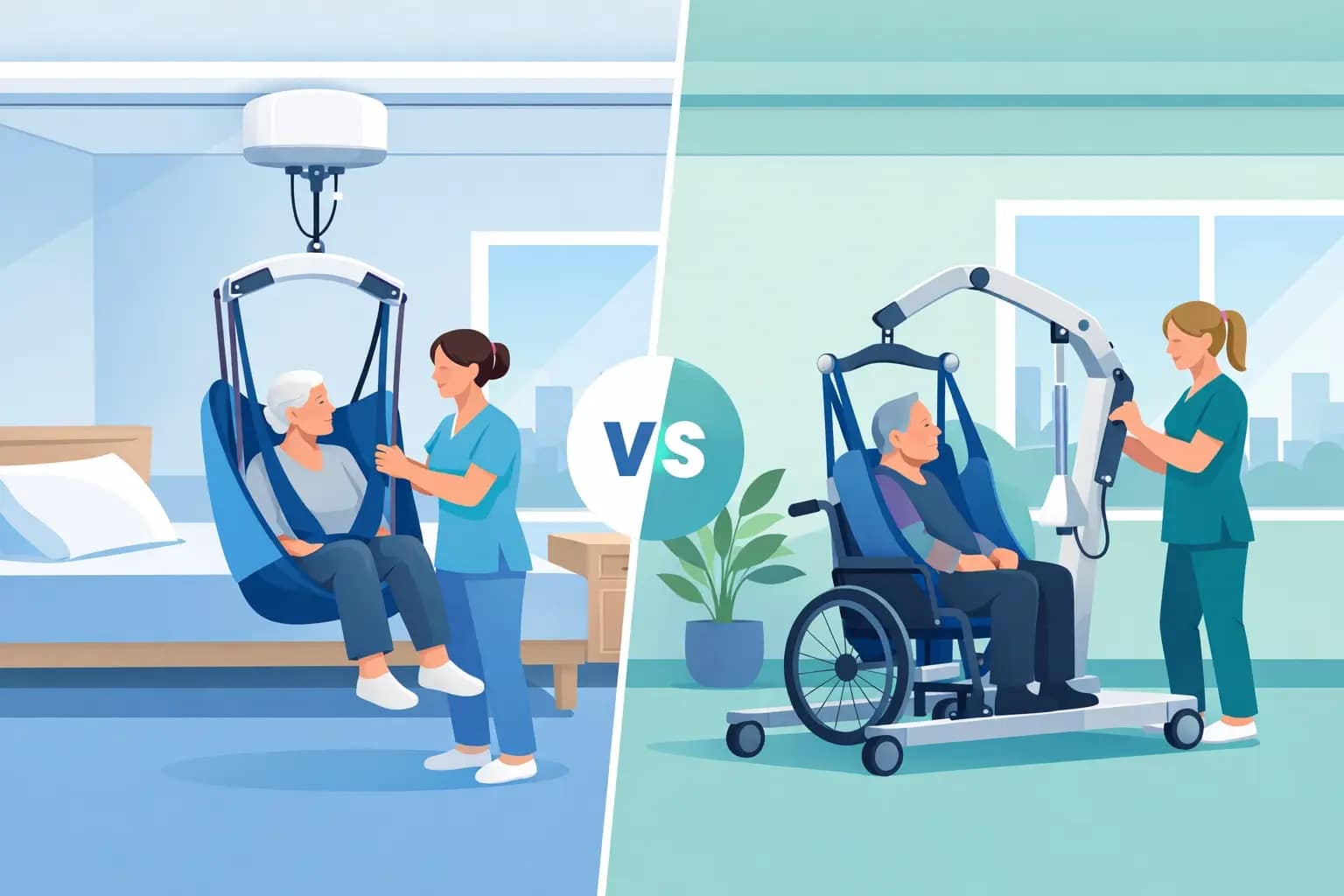
A ceiling hoist is mounted to an overhead track. The track may run in a straight line, cover a room using an H-frame arrangement, or connect rooms through a planned rail layout. The hoist unit travels along the track while the user is supported in a compatible sling.
A floor hoist is a mobile lifting unit on castors. It has a wheeled base, mast, lifting arm and spreader bar for attaching a sling. It can be moved around the home, provided there is enough clear floor space and suitable access through doorways.
In simple terms, a ceiling hoist uses overhead space to make transfers, while a floor hoist uses floor space. That distinction affects nearly every part of the decision, from room layout and installation requirements to daily handling and storage.
When a Ceiling Hoist May Be the Better Choice
A ceiling hoist is often suitable for households where transfers take place frequently in the same location. For example, a person who transfers each day between a profiling bed and wheelchair may benefit from a fixed track above the bed area. A track can also be planned to reach a bedside chair, changing area or bathroom, depending on the property and installation design.
The main advantage is clear floor space. Because the lifting equipment is overhead, there are no hoist legs to position around a chair, bed or commode. This can make a considerable difference in compact bedrooms and bathrooms, where turning a mobile hoist may be difficult.
Ceiling hoists can also reduce the physical effort involved for carers. With a correctly designed track, the user can be moved along a predictable route without pushing a heavy unit across carpet, thresholds or uneven flooring. This can be valuable where transfers are repeated throughout the day or where carers have their own mobility or back concerns.
Fixed coverage for regular transfer routes
The benefit of a ceiling hoist is also its limitation: it works where the track has been installed. If the main transfer route is well established, this is usually an advantage. The equipment is ready when needed and does not require storage in a corner or movement from room to room.
For a person whose needs are expected to remain long term, a ceiling hoist can form part of a wider home adaptation plan alongside a profiling bed, accessible bathroom, wet room or doorway alterations. It can make a familiar routine more manageable for the user and their carers.
Points to consider before installation
Ceiling hoists require a property assessment. The ceiling structure, room dimensions, door positions and intended transfer points all need to be considered. A suitable fixing method is necessary, and some homes may need structural work or a freestanding gantry-style solution rather than a ceiling-mounted rail.
Installation makes a ceiling hoist less flexible than a mobile model. It cannot simply be taken into another room if the person’s routine changes. There is also an upfront cost for the rail system and fitting, which should be weighed against the expected frequency and duration of use.
When a Floor Hoist May Be the Better Choice
A floor hoist can be a practical choice when transfers are needed in more than one room, when a permanent installation is not suitable, or when needs may change over time. As it is not fixed to the building, it can be positioned where required and moved between rooms where access allows.
This portability is particularly useful in a temporary recovery period following surgery or injury. It may also suit families who are still establishing which rooms work best for care, or who are not ready to make permanent changes to the property.
Mobile floor hoists are available in different designs and lifting capacities. Some have powered leg adjustment to help position the base around furniture, while others are designed with compact dimensions for more restricted spaces. The correct model still depends on the room, the user’s weight and height, and the transfer being completed.
The need for clear floor space
A floor hoist needs room to approach the user, open its legs where required, and turn safely. Furniture placement matters. Low beds, bulky armchairs, rugs, thick carpet and narrow doorways can all make use more difficult.
The flooring also affects day-to-day handling. A carer may find it harder to push a loaded floor hoist over deep-pile carpet or across raised thresholds. This does not automatically rule out a floor hoist, but it should be tested as part of the assessment rather than assumed to be manageable.
Storage is another consideration. When not in use, the hoist needs a safe, accessible place where it will not obstruct a walkway. In a smaller home, this can be harder to achieve than expected.
Compare the Practical Factors Before You Choose
The user’s transfer ability should lead the decision. Someone who can stand briefly and take some weight through their legs may be better suited to a standing transfer aid rather than a full sling hoist. A person with little or no weight-bearing ability will usually need a passive hoist and an appropriate sling. Never select lifting equipment based on a single feature or on another person’s experience.
Carer support matters just as much. Consider who will use the hoist, how often it will be used and whether one or two carers are needed for safe handling. A ceiling track may make a regular route easier to manage, while a floor hoist may provide more flexibility where different carers use different rooms.
Think about the property as it is now, but also how it may need to work later. A floor hoist can suit changing or short-term needs. A ceiling hoist can be more appropriate where there is an established long-term care routine and a clear transfer path. For rented properties, permission for installation may also be required.
Sling choice is part of the system, not an afterthought. Full-body, divided-leg, toileting and hygiene slings all support different tasks and levels of posture. The sling must fit the individual and be compatible with the hoist attachment points. An unsuitable sling can affect comfort, positioning and safety even when the hoist itself is appropriate.
Safety, Assessment and Ongoing Care
A moving and handling assessment from a qualified professional, such as an occupational therapist or trained assessor, should guide the purchase. This assessment can identify the right hoist type, safe working load, sling style, room layout and number of carers needed. It should also take account of pain, skin integrity, muscle tone, contractures, fatigue and the person’s ability to communicate during a transfer.
Check the safe working load for every component, including the hoist, track where fitted, spreader bar and sling. The lowest rated component determines the safe limit. Equipment should be inspected before use, with particular attention to sling fabric, stitching, loops, clips, straps, batteries and charging arrangements.
Hoists need servicing and, where applicable, statutory thorough examination at the required intervals. Keeping equipment maintained is not only about reliability. It helps ensure that lifting and lowering functions, emergency systems and structural parts remain safe for everyday use.
Making the Choice for Your Home
Choose a ceiling hoist when frequent transfers follow a regular route, floor space is limited and a permanent installation is practical. Choose a floor hoist when flexibility is the priority, transfers happen in different rooms or a fixed rail is not suitable for the property.
For many households, the best decision becomes clearer once the bed, chair, bathroom and doorways are considered as one daily route rather than separate spaces. Specialist advice can turn that route into a safer, more comfortable routine that supports independence and makes caring more manageable.